



Marketing is harder than ever. Buyers are busier, the noise is louder, and attention spans are shorter. You can spend weeks perfecting a campaign—only to watch it fall flat because it didn’t reach the right people in the right way.
But here’s the truth: even the most creative ideas won’t work if they’re aimed at the wrong audience. It’s like throwing darts blindfolded—you might get lucky once in a while, but most of the time you’ll miss the mark.
That’s why buyer personas matter. They’re the foundation for every smart marketing strategy, helping you understand not just who your audience is, but what they actually care about.
Without personas, marketing is guesswork. With them, it’s a roadmap to results.
In this guide, we’ll cover what personas are, why they matter, and how to build them the right way (with plenty of practical tips and examples along the way).
What is a buyer persona?
At its simplest, a buyer persona is a fictional representation of your ideal customer. But don’t let the word fictional fool you. These profiles are built on real data, customer insights, and conversations. A good persona blends the facts (like company size, industry, and role) with the emotional drivers (like fear of wasting budget or pressure to hit quarterly goals) that influence buying decisions.
Instead of saying, “We target marketing managers,” a persona gives you this:
Casey, Content Manager
Casey works at a growing healthcare tech company. She’s focused on building brand trust and generating leads through thought leadership content. Her challenge? She’s stretched thin—juggling multiple priorities with limited time and resources.
Now you know more than her job title—you understand her goals, frustrations, and where you can help.
Why buyer personas matter
Campaigns succeed or fail based on how well you understand your audience. Without that clarity, marketing turns into a guessing game—messages feel generic, sales calls stall, and growth slows. With personas, your team knows exactly who you’re speaking to, what problems they’re solving, and how your solution fits into their world. That shared understanding builds alignment—and results.
Two companies launch the same campaign at the same time:
- Company A builds around well-researched buyer personas.
- Company B relies on gut instinct (great for a seasoned salesperson, but hard to translate to all team members!)
At first, the results look similar. But within a quarter, the gap is obvious:
| Company A The persona-driven company is booking qualified meetings, closing deals and refining messaging with confidence. | Company B The other is chasing unqualified leads, stuck in misalignment between sales and marketing, and struggling to explain why growth has stalled. |
We’ve seen both sides of the spectrum—and that’s exactly why we advocate for the former.
The numbers back it up:
- 71% of companies that exceed revenue and lead goals have documented personas compared to just 26% of those that miss them.
- Marketers who use personas to map content to the buyer’s journey see 73% higher conversions from response to MQLs.
Personas don’t just define your audience—they align marketing, sales, product and customer success around the same buyer. That alignment shows up in revenue, retention and long-term growth.
💡Tip: Don’t silo personas as a marketing project. The best results happen when every team uses them to guide decisions.
What happens if you skip buyer personas?
Skip personas, and the cracks show fast.
Campaigns launch, but you’re left wondering why they don’t connect. Sales says the leads aren’t qualified. Marketing points to clicks and claims the strategy is working. Product builds features no one asked for. Everyone is busy, but nobody’s moving in the same direction.
We’ve seen companies pour serious time and money into strategies like these—only to discover the problem wasn’t the campaign. It was the missing foundation. Without personas, teams operate on assumptions. And assumptions don’t close deals.
The fallout usually looks like this:
- Campaigns miss the mark because they’re speaking to everyone instead of someone.
- Sales and marketing chase different targets, creating frustration on both sides.
- Leads come in, but they don’t convert because they’re the wrong fit.
- Messaging stays vague, blending into the noise instead of breaking through.
💡Tip: If your campaigns keep underperforming, ask this first: Did we build this for a real persona—or for a vague idea of an audience? That simple check can save you from pouring more budget into the wrong direction.
How to build buyer personas (the Accelity way)
Building personas isn’t about filling out a worksheet—it’s about uncovering what truly drives your buyers.
At Accelity, we follow a process that blends client knowledge with outside research to make sure every persona is rooted in reality, not guessing.
1. Start with discovery workshops
We capture what your team already knows about your audience. These conversations surface the hypotheses that shape your strategy and pressure-test the assumptions behind it.
2. Validate with research
Internal input is a starting point. As Michael Ray, our Strategic Marketing Director, emphasizes, you need outside voices to build personas that actually work. That means customer interviews, surveys, third-party research and CRM data—not just what your team believes to be true.
3. Dig deeper than surface-level
Efficiency and cost savings are common answers. Stephanie Roland, our Strategic Brand & Marketing Director, challenges teams to go further: “If someone says ‘I want efficiency,’ ask what efficiency really means to them. Does it save time, reduce stress or help them earn credibility with leadership? That’s the difference between a shallow persona and a useful one.”
4. Document thoroughly
Strong personas capture demographics, psychographics, buying behavior and content preferences. Done right, they become tools marketing, sales and product can rely on—not files that collect dust.
5. Update regularly
Markets shift. Priorities change. The best companies revisit personas at least every six months to stay sharp and relevant.
💡 Tip: Start with 2–3 core personas that represent your highest-value buyers. You can expand later. What matters most is creating ones that your team will actually use.
What to include in a buyer persona
A strong persona is more than a name and job title—it’s a full story of who your buyer is and what drives their decisions. Here are the core elements to include:
- Demographics: Job title, company size, education, location
- Psychographics: Motivations, goals, challenges
- Story: Role, responsibilities, tools they use, communication styl.
- Buying behavior: Are they a decision-maker, influencer or blocker? What drives their choices?
- Content & communication: What they like to read, watch or listen to, and where they spend their time
Our strategist Stephanie reminds clients that this is where most teams fall short:
“Emotional and rational frustrations and barriers matter. What challenges do they experience in their role? What gets in the way of success—or keeps them up at night? Don’t just stop at, ‘They’re risk-averse.’ Push further: What’s preventing them from trusting your product or your category? Are there perceptions about your brand that need to be addressed?”
That’s how you move from surface-level profiles to personas that actually shape strategy.
💡Tip: Don’t just document what makes your buyers say “yes.” Spend equal time on what makes them hesitate or say “no.” Those insights are often the most valuable.
The right personas change everything
Strong personas are the difference between campaigns that connect and campaigns that fizzle. With them, you’ll create sharper messaging, have stronger sales conversations, and build smarter growth strategies.
Companies that invest in personas see clearer alignment, stronger pipelines, and more sustainable growth. The ones that don’t often end up stuck chasing the wrong audience or struggling to explain why results have stalled.Want help building buying personas that will transform your messaging? Let’s talk marketing services.
Getting a form fill is exciting—but it’s not the finish line. In fact, it’s just the beginning.
The biggest mistake we see with inbound marketing? Treating a lead like a win instead of a warm-up. Capturing a contact is the easy part. Nurturing that lead into a real opportunity takes strategy, content and a team that knows what to do next.
Generating leads is only the first step to taking new contacts through the sales cycle until they make a purchase decision. Think of this as the “first date.”
This blog breaks down how to keep momentum after conversion—with smart workflows, personalized content and a sales team that’s ready to pounce (nicely).
Set up email workflows
When someone downloads a content offer, that’s a strong buying signal—they’re interested in a specific topic and ready to learn more. Use this moment to trigger an email workflow that delivers related, valuable content. These workflows help “warm up” leads by sharing content that expands on their interests.
The key is to make sure every email has a clear goal and strong purpose. What should the lead do next? Examples of workflow goals include:
- Request a consultation
- Download another offer
- Visit your website
- Subscribe to your blog or newsletter
Once you set your goal, line up content that directly supports it. If your original offer was an ebook on graphic design best practices for startups, follow it up with a blog on website branding tips or a video tutorial on design tools.
Make sure your workflows:
- Include time between emails. Avoid overwhelming your leads with daily emails. Test different sending cadences to see what keeps engagement high without burnout.
- Feature a strong CTA. Don’t dance around your ask—be direct. If your goal is to drive consultation requests, include specific messaging and a clear link to your consultation page.
- Have a logical end point. Don’t let your workflow run indefinitely. Send just enough touchpoints to guide the lead forward—then give them breathing room.
Bonus tip: Use AI to personalize email workflows. Modern marketing platforms can dynamically adjust workflow content and cadence based on lead behavior, helping you tailor each interaction without manual effort. Think Netflix-level personalization for your sales funnel.
Email workflows make sure that the first download isn’t a one-and-done interaction. They provide steady, purposeful engagement that builds trust and ultimately boosts conversions.
Build quality content for the entire inbound process
Once a lead has converted, your job is to keep them moving. That means creating content that not only informs but strategically nudges them toward a buying decision.
Start by mapping content to each stage of the buyer’s journey. Ask yourself:
- What questions does a buyer have at this stage?
- What content will build confidence and address their challenges?
- How can we move them to the next step?
Here’s a breakdown.
| Conversion stage | Goal | Appealing content |
| Strangers to visitors | Grab attention | Use social posts, blogs, and high-volume keywords to appeal to your target audience. |
| Visitors to leads | Encourage action | Offer easily digestible, relevant content specific to certain industries or interests like checklists, guides or short webinars. |
| Leads to customers | Build trust | Share content that connects your solution to their goals—like case studies, demos or landing pages. These can also be used in email workflows. |
| Customers to promoters | Spark loyalty | Provide VIP-level content, sneak peeks and early access. Ask for their input and make them feel seen. |
Pro tip: AI can help identify which stage your leads are in. Tools like predictive analytics and engagement tracking use behavioral data to automatically segment leads and serve the right content at the right time.
Understand lead scoring
Wondering whether your lead nurturing efforts are actually working?
Lead scoring helps you quantify how engaged a contact is, so you can identify which leads are worth a closer look from sales. Once a lead reaches a defined threshold, they’re considered marketing qualified—and ready for direct outreach.
To build a lead scoring system that actually works, you need to define what makes a lead qualified. According to HubSpot, a marketing qualified lead is one who’s more likely to become a customer based on both demographics and engagement behavior.
Here are some scoring criteria to consider:
- Persona
- Industry
- Number of clients
- Company size or number of employees
- Number of downloads
- Website visits
- Email opens or click-throughs
And remember: a score can be less than zero. For example, If your business is a pet store and one of your personas is a non-pet owner, you’d likely apply a negative score.
Of course, the main goal of lead scoring is to move people to become qualified, so you’ll need to consider what each scoring criterion is worth to you and your business.
If someone identifies as a “multiple pet owner,” you’ll need to consider what that information is worth. Do you find that most of your customers are multiple pet owners? If so, you may want to score that persona at a higher level. Go through your list of prospect attributes and make sure the value that you apply to each makes sense.
| Testing Theory You’ve set your lead scoring threshold at 15 points—that’s the magic number that signals when a lead is ready for sales outreach. You’ve created a scoring system that blends both persona and engagement data. Someone who owns multiple pets gets five points right off the bat. A single pet owner scores three. But if the person doesn’t own any pets at all? That’s a red flag for your business, so they get docked 20 points.Beyond personas, you’re also tracking behavior. Every time someone visits your website, they earn a point. If they download a piece of content—say, a guide on choosing the right food for senior dogs—that’s another point. If they open an email and click a link, that’s another one. If they spend time reading your testimonials, they earn two points. And if they start browsing product pages, especially high-intent ones like pet carriers or subscription boxes, that’s worth three points.Over time, a highly engaged lead who fits your target profile racks up points naturally—until they cross that 15-point threshold (at which point sales should be ready to pounce—nicely!). |
Once someone crosses your MQL threshold, sales should reach out with a friendly, helpful message tailored to their behavior. Think of it as the digital equivalent of “May I help you find something?”—but smarter, more strategic, and way more effective.
Pro tip: AI tools like HubSpot’s predictive lead scoring can automatically assign scores based on behavioral patterns and historical customer data—no manual math required.
Finally, don’t “set it and forget it.” Lead scoring works best with:
- Regular updates based on actual conversion data
- Feedback loops with sales (they know what’s working!)
- Score thresholds that reflect real buying behavior, not vanity metrics
Lead scoring is part science, part strategy, and it takes collaboration and iteration to get right.
Give sales the content they need to succeed
Inbound doesn’t stop at marketing. It includes sales, and the two teams need to be synced.
A huge part of inbound marketing is content creation, and if you’ve ever been a marketer or salesperson, you know that sales always needs fresh, relevant and tailored content to keep engagement high and close deals. Think ebooks, blog posts, checklists, videos—anything that helps build credibility and move conversations forward.
To keep engagement high post-conversion, work closely with sales using strategies like:
- Regular meetings. Biweekly or monthly planning sessions help marketing understand sales’ challenges and content needs.
- Sales-written content. Ask your sales reps to contribute to the blog or collaborate on thought leadership pieces. It builds authority and saves you time.
- Content performance analysis. Use analytics to see what content is working. If one lead magnet crushes it, use that format again or, build deeper content around the same topic.
- Message alignment. Sales should understand the story behind every piece of content so they can reference it with confidence. For example:
- Instead of saying, “I saw you downloaded our ebook, so I thought I’d call,” try, “I saw you downloaded our ebook on increasing workplace productivity. I’d love to share a few strategies we’ve seen work for companies like yours.”
Future-forward move: Use AI content assistants like Clay to generate custom follow-up scripts and conversation starters based on each lead’s interaction history.
Sales and marketing should be a well-oiled machine. When both teams align on strategy, messaging and goals, the result is clear: more qualified leads, more closed deals and stronger revenue growth.
The conversion isn’t the end—it’s the starting line
By combining strategic content, smart automation and ongoing collaboration with sales, you’ll move more leads through the funnel—and close more deals, faster.
This blog is part of our inbound marketing series:
- Part 1: Build a lead pipeline that doesn’t waste your time
- Part 3: How to keep growing with retention marketing
Sales and marketing used to be a grind. Cold calls, cold emails, cold coffee (because you were too busy to drink it while it was hot). Every new lead was a shot in the dark, and even the best sales pros could only hustle so hard before burnout set in.
But here’s the good news: we’re not doing that anymore.
Today, inbound marketing flips the old model on its head. Instead of chasing down leads with generic pitches, you’re drawing in the right people—those already searching for what you offer—with content that educates, engages and builds trust.
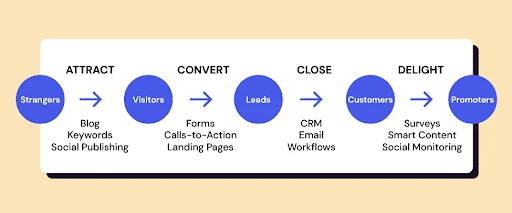
Inbound marketing isn’t about chasing leads—it’s about earning their attention. It’s attracting the right people: the ones already exploring their options, researching solutions, and—believe it or not—wanting to talk to sales. But that kind of lead doesn’t just appear out of thin air. The process starts long before your sales team picks up the phone.
How do you get these leads into your pipeline? Let’s get into it.
Start with buyer personas that actually reflect your best customers
Before you write a single blog or build a landing page, you need to define your audience. This is where detailed, research-backed buyer personas come into play.
Your personas should be based on:
- Real customer interviews and behavior patterns
- Deal data from your CRM
- Insights from your sales and customer success teams
And they should answer questions like:
- What goals are they trying to achieve?
- What challenges are they up against?
- What questions do they ask during the sales process?
- Where do they go for information?
Once you’ve built strong personas, zoom in. Pick one or two to focus your campaign on—ideally, those that generate the most revenue or represent high-retention accounts. Tailoring your message to a tightly defined audience makes your content feel like it was written just for them (because it was).
Here’s the key: don’t overcomplicate it. A few detailed personas based on high-revenue or high-retention segments will serve you way better than a bloated list you never use.
Create content that’s specific, useful, and tailored to the buyer’s journey
Once you know your audience, you can start mapping content to their needs at each stage of their journey:
- Awareness: Blog posts, social content, infographics, and educational videos that highlight pain points and introduce solutions.
- Consideration: Comparison guides, case studies, gated resources, and webinars that help buyers evaluate their options.
- Decision: Testimonials, pricing pages, product demos, and consult offers that build trust and move prospects forward.
Use formats that actually make sense for your audience. If your persona doesn’t know what a meme is (or doesn’t care), skip it. If they don’t have time for a 40-page white paper, don’t write one. Great content in the wrong format is as ineffective as no content at all.
It’s not just about churning out more content—it’s about producing the right content and optimizing it for discoverability. That means:
- Building around SEO clusters and topic authority
- Refreshing old posts with updated stats and stronger CTAs
- Creating content formats that match buyer preferences (think: e-books or interactive tools)
Align sales and marketing to qualify faster and better
Modern inbound strategy means working closely with sales to define what a qualified lead looks like together. That could include:
- Lead scoring based on behaviors and attributes (downloaded a case study + visited pricing page)
- Automated routing and personalization in your email sequences
- Clear handoff points that feel like a continuation of the conversation, not a cold restart
The goal? A smoother path from stranger to SQL, and fewer wasted hours on leads that were never going to close.
When you build your inbound engine around real customer insights and content that speaks to specific needs, you fill your pipeline with people who are more likely to convert. That means less time qualifying, more time closing—and way fewer hair-pulling cold calls.
Ready to make leads come to you?
When you build your inbound engine around real customer insights and content that speaks to specific needs, you fill your pipeline with people who are more likely to convert. That means less time qualifying, more time closing—and way fewer hair-pulling cold calls.
This blog is part of our inbound marketing series: