




Every few years, marketing goes through a panic cycle.
“SEO is dead.”
“Search has changed forever.”
“If you’re not doing this new thing, you’re already behind.”
But in the last couple of years, AI has absolutely changed the game. Generative search experiences are reshaping how people find answers. Content is being summarized, synthesized and surfaced in new ways. The way we search—and the way we create content—has shifted.
And if you’re a founder, CMO or sales leader trying to keep revenue moving, it’s easy to feel like you missed a memo somewhere.
Now we’re debating what to call it (GEO, AEO, AI optimization; pick your acronym, we chose GEO), and the pressure ramps up again.
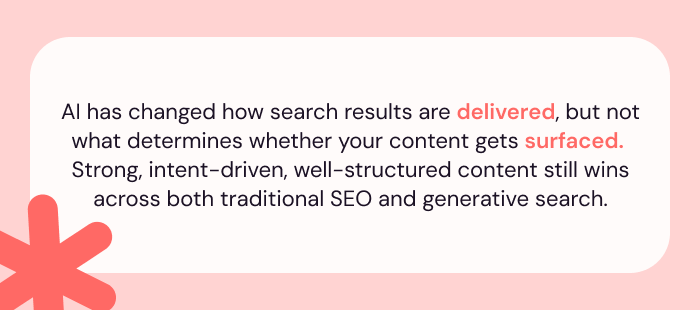
Here’s the steadier truth: yes, search is evolving. But the foundation that drives visibility hasn’t changed as much as the headlines suggest.
What actually changed between SEO and GEO
Generative engine optimization (GEO) refers to structuring and developing content so it can be cited, summarized or referenced within AI-generated search experiences. There are differences between traditional SEO and generative optimization. It helps to understand them without overdramatizing them.
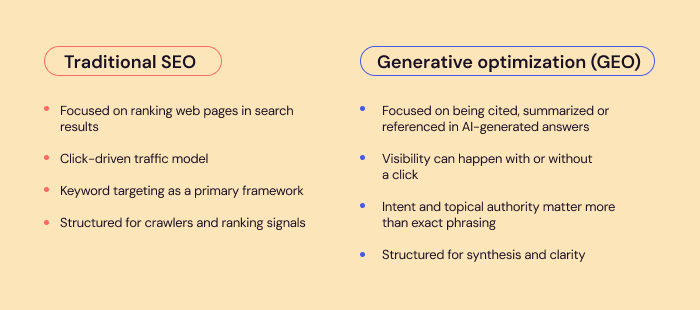
In traditional SEO, your goal is to rank high enough to earn the click.
In generative environments, your content may be pulled into a summary, quoted or used as a source. That means clarity, structure and authority matter even more. Engines are trying to answer a question well. They need strong source material to do it.
The good news is that while the mechanics have shifted, the selection criteria are more similar than they are different.
The signals that still matter in SEO and GEO
Underneath the acronyms, the core signals remain remarkably consistent.
Both search engines and generative engines prioritize content that:
- Clearly answers a real question.
- Aligns with specific user intent.
- Demonstrates depth and expertise.
- Is structured in a logical, easy-to-follow way.
- Builds trust through specificity, examples and proof.
The philosophy is still this: create content that genuinely helps your ICP make better decisions..That doesn’t mean trying to outsmart an algorithm or publishing high-volume content that says very little. It means writing the piece your ideal buyer was hoping to find: clear, specific and actually useful to the decision they’re trying to make.
Why fundamentals travel across platforms
Well-built content adapts.
When you deeply understand your ICP’s questions and build comprehensive, well-structured content around them, you create assets that:
- Rank in traditional search.
- Get pulled into AI summaries.
- Support sales conversations.
- Increase engagement and time on page.
- Compound in authority over time.
Weak, trend-chasing content breaks every time the rules shift. It’s optimized for a moment, not for durability.
Strategic content, on the other hand, has range. It survives updates because it wasn’t created to exploit a search tactic. It was created to genuinely answer a question well.
When you focus on the core principles, platform evolution becomes an amplification opportunity, not a disruption.
Feeling overwhelmed? Focus here first.
Instead of overhauling everything, start with these priorities.
Define your ICP with precision
If your content tries to speak to everyone, it resonates with no one. Get specific about who you’re targeting and what they are actually worried about, researching or comparing.
Build around real questions
Use sales calls, customer interviews and search data to identify the questions that repeatedly surface. Then answer them directly and thoroughly.
Go deeper on fewer topics
Topical authority matters more than scattered coverage. Own a cluster of issues that are central to your buyer’s decision process.
Structure for clarity
Clear headings. Direct answers. Logical flow. This helps humans, crawlers and generative engines understand your expertise.
Improve before you expand
Before publishing net-new content, revisit high-intent pages. Expand them. Clarify them. Strengthen proof. Optimization often means refinement, not addition.
Where tactical adjustments do matter
This isn’t an argument to ignore change. There are refinements worth making, for example:
- Clear formatting matters more than ever, especially as AI systems pull and synthesize information.
- Scannable headings help both users and generative engines understand what you’re actually saying.
- Internal linking strengthens topical authority and reinforces how your expertise connects.
- Entity clarity—who you are, what you do and who you serve—reduces ambiguity for both humans and machines.
- Demonstrating real-world expertise through examples, proof and specificity builds trust.
You may also consider:
- Adding concise summary sections where helpful.
- Incorporating FAQ expansions when they match real intent.
- Tightening introductions to answer the core question faster.
These are meaningful improvements, but they don’t replace the need for strong, thoughtful content in the first place.
If the foundation isn’t there, formatting tweaks won’t save it. If the foundation is strong, these changes just help it go further.
Search will change, but strategy shouldn’t
The bigger mistake right now isn’t ignoring GEO. It’s overreacting to it.
When leaders feel behind, they chase tactics and acronyms instead of strengthening the foundation: ICP clarity, aligned messaging, depth of expertise and consistent, useful content. But generative engines still rely on strong source material. Search engines still reward relevance and authority. And buyers still want clear answers.
Search will keep changing. It always has. New formats will emerge and new terms will trend.
The teams that stay grounded in fundamentals won’t have to reinvent themselves every time that happens. They’ll already be building the kind of content that works—no matter what we decide to call it.
Subscribe to our newsletter
Curated content, news articles, team updates and more.
