



In today’s crowded markets, even the most innovative brand can struggle to stand out. Buyers are overwhelmed, competition is fierce and attention is fleeting. If you’ve ever felt like your messaging is hitting some of the mark but not all of it, buyer journey mapping may be the missing link.
Journey mapping gives you a clearer view of how people move from “I think I have a problem…” to “This is the solution I’m choosing.” It’s a simple but powerful way to ensure your content and campaigns actually meet your buyers where they are, emotionally and logically, at every step.
Let’s break down what journey mapping is, why it matters and when you should build one.
What is buyer/consumer journey mapping?
Buyer journey mapping is the process of visualizing the stages your customer moves through as they go from awareness to purchase and beyond. Think of it as creating a roadmap of your buyer’s experience: what they’re doing, thinking and feeling along the way.
A strong journey map includes:
- Stages: Awareness, consideration, decision and often post-purchase.
- Buyer goals and motivations: What they’re trying to achieve at each step. What pushes them to move forward.
- Pain points/barriers: What are the challenges and frustrations they’re experiencing? What’s slowing them down or making them hesitate about purchasing your product or similar products?
- Key questions: What they’re trying to understand or validate.
- Channels: Where do they seek out information? Where they spend their time and where you can reach them.
- Content opportunities: What you can create to help them progress.
At its best, a journey map pulls together insights from sales, customer feedback, analytics, interviews and your content performance. It’s both practical and empathetic; half strategy, half understanding your buyer as a real human.
Why is journey mapping important?
1. It reveals barriers at every stage
Every buyer faces friction: confusion, skepticism, overwhelm or even plain old inertia. Journey mapping helps you uncover those barriers so you can address them in your content instead of crossing your fingers and hoping buyers figure it out on their own.
2. It helps you say the right thing at the right time
When you know a buyer’s questions and emotions at each stage, your messaging becomes sharper and more helpful. Instead of guessing, you’re guiding. That alignment builds confidence for both you and your customers.
3. It organizes all your buyer insights in one place
Marketers often have bits of buyer data scattered everywhere. A journey map brings those insights together into a clear, unified view. Suddenly, marketing, sales, product and leadership are speaking the same language.
4. It shows you which channels matter most
Everyone’s tired of wasting budget on channels that don’t move the needle. Journey mapping points you to where your audience is paying attention at each stage, so your campaigns meet buyers exactly where they’re looking.
5. It strengthens your content strategy
Need to know what content to create? What gaps you have? What needs a refresh? Your journey map can tell you. It becomes a reliable roadmap for building targeted, effective, full-funnel content.
When should you build a journey map?
Short answer: any time you want clarity. But there are a few moments when journey mapping is especially powerful:
- Before launching a new campaign
- When targeting a new persona or market
- When rebranding or repositioning
- When you see shifts in customer behavior
- During annual or semi-annual content planning
If something in your marketing feels “off” or you’re guessing at messaging, that’s a sign it’s time to map.
What does a journey map look like?
A journey map can take many forms: a spreadsheet, a visual diagram, a whiteboard full of sticky notes, but the format isn’t the point. What matters is that it helps you see the customer experience clearly: what they’re trying to accomplish, where they feel confident, where they hesitate and where they need more support to move forward.
To bring this to life, imagine evaluating a new analytics platform:
- Awareness: They’re frustrated with unreliable attribution reporting. They begin searching for best practices, downloading guides and reading thought-leadership articles.
- Consideration: They explore different types of solutions, platforms, agencies and custom dashboards. They compare case studies, attend webinars and cross-check peers’ recommendations.
- Decision: They’ve narrowed it to two vendors. Now they’re focused on pricing transparency, integration requirements, onboarding speed and customer proof. Demos and reference calls matter most here.
A journey map illustrates this flow in a way that lets your team quickly identify opportunities to reduce friction and increase clarity. Instead of guessing, you’re aligning your message with the questions and emotions your buyer experiences along the way.
Depending on your goals, your journey map may highlight:
- A linear path, moving cleanly from awareness → consideration → decision
- An emotion-centered view, focusing on feelings like confidence, uncertainty or urgency
- A multi-path journey, ideal for complex buying committees or enterprise sales
- A post-purchase journey, designed to improve onboarding, retention or loyalty
No matter the structure, the best journey maps don’t just document steps; they tell a story. They help you understand what your buyers need and give your marketing, sales and product teams a shared lens for serving them better and supporting them at exactly the right moments.
Final thoughts
Journey mapping isn’t just a marketing exercise… it’s a strategic advantage. It brings clarity, alignment and intention to your campaigns. It helps you create content that genuinely resonates. And it gives your team the confidence to communicate with precision, not guesswork.
If you want your marketing to feel more connected, more human and more effective, a buyer journey map is the best place to start.
When Accelity signs on a new client, our copy team has 6 weeks to sound like we’ve worked with them for years. That means we need to quickly understand the ins and outs of their business, industry, customers and communication style.
To make that happen, we follow a tight onboarding process that goes way beyond surface-level brand notes. We dig into buyer personas, conduct competitive research and SEO audits, and lead interactive workshops to uncover the voice, tone and brand story that makes each company unique.
This isn’t just helpful for us, it’s a valuable process for any business looking to tighten up their content strategy. Whether you’re B2B, B2B2C, B2G or B2NGO, aligning your brand’s voice and style across channels matters.
Here’s a look at how we do it—and what you can borrow for your own brand.
Brand personality and voice
Not every brand can, or should, say things like, “Our software is so crazy good, you’ll totally save a ton of time!” Your personality should match your audience’s expectations and your company’s goals.
Here’s how some example brand traits listed above translate into a brand writing style:
- Expert = Confident, not boastful. Prioritize clarity and insights over buzzwords.
- Bold = Direct and decisive. Don’t hedge. Take a stance.
- Precise = Cut the fluff. Say only what needs to be said.
- Trusted = Cite credible sources and ground opinions in industry facts.
- Innovative = Avoid the status quo. Focus on what’s next.
We’re not just looking to write in your voice—we want to embody your perspective. That means looking at how your team naturally speaks, what your audience responds to, and what role your brand plays in the market. Do you educate? Challenge the status quo? Reassure customers with a sense of stability? We shape your voice around what makes your brand stand out.
We also review your existing materials—website copy, social media, one-pagers, email campaigns—to identify inconsistencies and opportunities. And we work with your team to close the gaps.
From traits to tone: building your brand style
Once we land on brand traits, we translate them into a brand style guide—something every Accelity client walks away with. This isn’t a dry rules document; it’s a living, breathing reference our team and yours can use to write like one voice, across every channel.
Your guide covers things like:
- Tone of voice by channel (e.g., confident on LinkedIn, helpful in email nurture)
- Sentence structure and word choice
- What to say… and what not to
- Guidelines for formatting, punctuation and emojis (yes, we have rules for emojis)
We also share examples of “good, better, best” writing for your brand, so internal teams can understand how to apply the guide in real life.
Here’s an example of an awesome brand style guide from Firefox that covers visual and written brand—something we create for our clients too!
This brand style shows up everywhere—from your website copy to your outbound emails to your product descriptions. And the more consistent your voice, the more memorable your brand becomes.
How we uncover your messaging
Some companies come to us with a full brand book, audience research and content goals already defined. Others are still figuring out their value proposition. Either way, we meet you where you are.
Through facilitated workshops and interviews, we help companies:
- Identify their brand archetype
- Clarify their brand story and positioning
- Define and prioritize value propositions
- Create content pillars that shape their strategy
These aren’t off-the-shelf exercises. They’re guided by what your business needs. A startup trying to gain traction has different messaging priorities than a growth-stage company expanding into a new market. We adapt the process accordingly.
And while the outcomes are strategic, the process is creative and collaborative. We believe your team should walk away not just with deliverables, but with clarity. Knowing who you are, how you talk about your work and why it matters.
We get personal
As part of marketing a brand, we often write on behalf of individuals within the companies we support. (Personal brands are a huge growth opportunity and help generate trust.) Founders, executives, and subject matter experts need to show up consistently across channels. And we help make that happen.
We use a similar voice and style process to write for individuals:
- We review past writing, interviews or LinkedIn posts.
- We conduct a short voice activity to define tone, topics and takeaways.
- We map out goals for each content type (thought leadership, recruiting, brand building, etc.).
And most importantly, we listen. What someone wants to sound like and how they actually sound can be two different things. We align those pieces to make sure personal content feels authentic and aligned with the larger brand.
Copy that grows with your company
Your brand will evolve—and your voice should, too. We create documentation and systems that scale with you, so no matter who writes your content next quarter (or next year), they’ll sound like part of the team.
When it all comes together, your brand voice becomes more than just a marketing tool. It becomes a signal of who you are, what you believe, and how you work. It builds trust before you ever hop on a sales call. And it sets you apart in a crowded market.
At Accelity, we build that voice from the ground up, then bring it to life with content that gets results. That’s because great copy isn’t about writing more… it’s about saying the right thing, the right way, every time.
👋 Reach out to us here if you need help aligning your brand with your message.
This blog was originally published in 2023 and has been updated regularly; the last update was June 2025. At Accelity, we’re always testing new tools to help us work smarter and better serve our clients.
For every think piece warning about the dangers of AI, there’s another mocking its inability to handle what humans consider basic tasks. And fair—AI still can’t crank out final-ready copy or generate an image without at least six fingers involved.
But here’s where AI does shine: strategy. It’s not your replacement—it’s your brainstorming buddy. It’s a catalyst that helps marketers move from concept to execution. With the right prompts, it can surface sharp insights about your brand, your competitors and your audience—all before lunch.
It’s like having a coworker to bounce ideas off… if that coworker was trained on decades of data and didn’t steal your leftovers from the breakroom.
We asked our Strategic Brand & Marketing Director, Stephanie Roland, how she uses ChatGPT to leverage insights, validate hunches, and spark fresh ideas for clients.
A note on ChatGPT—AI tools for marketers have existed for years, but the conversation gained momentum with OpenAI’s ChatGPT release in November 2022. This freemium chatbot became the fastest-growing app in internet history. While other tools like Perplexity are becoming all the rage, we’ll focus on ChatGPT, its reinforcement learning model and how it specifically supports brainstorming and strategy.
4 ways marketers can use AI for campaign strategy
1. Idea generation
ChatGPT’s responses range from boringly traditional to wildly innovative, making it a hilariously fun tool for brainstorming. By providing details about your target audience, goals, and objectives, ChatGPT can offer a variety of concepts and campaign angles to explore.
Strategy consultant Julian Cole shared a wealth of insightful prompts for using ChatGPT in campaign development during his webinars.
One of our favorites? Asking ChatGPT to generate r/showerthoughts about a topic, industry, brand or product.

These responses won’t go viral on LinkedIn as-is, but they can get the wheels turning to help you come up with a new post idea for growing your personal brand.
2. Audience analysis
Building a solid buyer persona strategy starts with knowing who you’re marketing to—and the research can be a time suck. ChatGPT helps speed things up by summarizing audience info and even uncovering new personas, giving you a broader view of your target market.
Thanks to the handy chat format, you can ask follow-up questions about customer demographics, preferences, and behavior to better understand your audience and tailor campaigns accordingly.
We wanted to test it out. Here’s a snippet of the impressively detailed persona it created for us based on a super simple prompt.
Prompt: Create a buyer persona for the founder of a tech startup where they are the only employee.
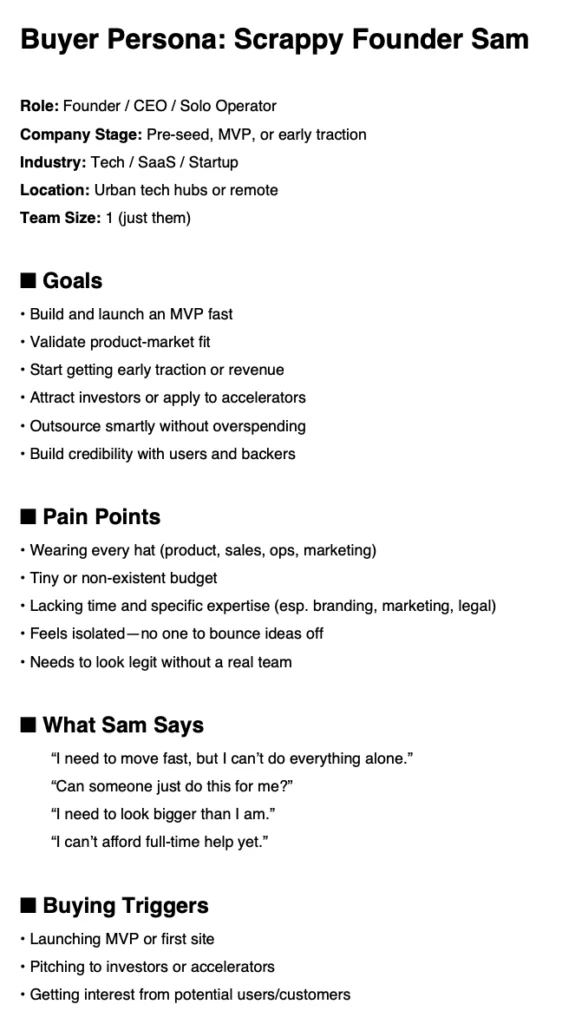
By outsourcing your personas to AI, you can begin with a foundation that you tweak and evolve over time, rather than starting with a blank page.
3. Messaging and positioning
Developing the perfect brand messaging statements can take hours of finding exactly the right words. Marketers can use ChatGPT to rework and refine their messaging and positioning strategies. By discussing the unique selling points of a product or service, target audience needs, and competitive landscape, ChatGPT can provide suggestions and help optimize marketing messages for maximum impact.
Here’s the brand messaging statement ChatGPT wrote for MediConnectPro, a fake healthtech it also created earlier in the chat:

4. Competitive analysis
Yes, you can go to each competitor’s website and spend time clicking through all the pages, reading their content, and checking their social (and you should still do that, too). But ChatGPT can synthesize what it knows about competitors quickly to help you get a high-level overview of the competition. You can even ask follow-up questions to find opportunities to outperform in areas where the competitor brand is lacking.

When NOT to use AI for campaign strategy
The common refrain when using AI is to proceed with caution; even ChatGPT now has disclaimers at the end of some of its responses, reminding people that it isn’t always accurate.
When asked about the benefits of using ChatGPT for campaign strategy, it added this caveat:
It’s important to note that while ChatGPT can provide valuable insights and recommendations, it’s always advisable to combine AI-generated suggestions with human expertise and critical thinking to create well-rounded marketing campaign strategies.
See? Even the robot agrees: AI works best with human expertise.
With that reminder, it’s important to note that AI shouldn’t be your only tool. Here’s why:
- AI cannot develop the campaign for you. You know the client or brand much better than AI. You’ll need to add the human element—empathy, humor, culture, etc.—to make the campaign successful.
- AI isn’t “set it and forget it.” First, you need to verify that the information ChatGPT provided is accurate. You’ll also need to continue to test and optimize what you found in the brainstorming stage.
- AI doesn’t have the most up-to-date information. If your competitor is relatively new, or you want to build a campaign around a new product, ChatGPT likely won’t be useful as its models were trained in 2021.
Kickstart your strategy with the help of AI
When it comes to brainstorming and uncovering new ideas, ChatGPT’s wacky responses are an advantage. Bouncing ideas off of the robot can help you think about a problem or solution in a totally different way, uncovering the seed that will eventually become your super-effective strategy. While marketers should always make sure to verify and monitor AI outputs, the ideas it can generate will help unlock insights you might never have imagined.
Want to bounce your ideas off a team of (human) marketing experts? 😉 Hit us up here.
Marketing is harder than ever. Buyers are busier, the noise is louder, and attention spans are shorter. You can spend weeks perfecting a campaign—only to watch it fall flat because it didn’t reach the right people in the right way.
But here’s the truth: even the most creative ideas won’t work if they’re aimed at the wrong audience. It’s like throwing darts blindfolded—you might get lucky once in a while, but most of the time you’ll miss the mark.
That’s why buyer personas matter. They’re the foundation for every smart marketing strategy, helping you understand not just who your audience is, but what they actually care about.
Without personas, marketing is guesswork. With them, it’s a roadmap to results.
In this guide, we’ll cover what personas are, why they matter, and how to build them the right way (with plenty of practical tips and examples along the way).
What is a buyer persona?
At its simplest, a buyer persona is a fictional representation of your ideal customer. But don’t let the word fictional fool you. These profiles are built on real data, customer insights, and conversations. A good persona blends the facts (like company size, industry, and role) with the emotional drivers (like fear of wasting budget or pressure to hit quarterly goals) that influence buying decisions.
Instead of saying, “We target marketing managers,” a persona gives you this:
Casey, Content Manager
Casey works at a growing healthcare tech company. She’s focused on building brand trust and generating leads through thought leadership content. Her challenge? She’s stretched thin—juggling multiple priorities with limited time and resources.
Now you know more than her job title—you understand her goals, frustrations, and where you can help.
Why buyer personas matter
Campaigns succeed or fail based on how well you understand your audience. Without that clarity, marketing turns into a guessing game—messages feel generic, sales calls stall, and growth slows. With personas, your team knows exactly who you’re speaking to, what problems they’re solving, and how your solution fits into their world. That shared understanding builds alignment—and results.
Two companies launch the same campaign at the same time:
- Company A builds around well-researched buyer personas.
- Company B relies on gut instinct (great for a seasoned salesperson, but hard to translate to all team members!)
At first, the results look similar. But within a quarter, the gap is obvious:
| Company A The persona-driven company is booking qualified meetings, closing deals and refining messaging with confidence. | Company B The other is chasing unqualified leads, stuck in misalignment between sales and marketing, and struggling to explain why growth has stalled. |
We’ve seen both sides of the spectrum—and that’s exactly why we advocate for the former.
The numbers back it up:
- 71% of companies that exceed revenue and lead goals have documented personas compared to just 26% of those that miss them.
- Marketers who use personas to map content to the buyer’s journey see 73% higher conversions from response to MQLs.
Personas don’t just define your audience—they align marketing, sales, product and customer success around the same buyer. That alignment shows up in revenue, retention and long-term growth.
💡Tip: Don’t silo personas as a marketing project. The best results happen when every team uses them to guide decisions.
What happens if you skip buyer personas?
Skip personas, and the cracks show fast.
Campaigns launch, but you’re left wondering why they don’t connect. Sales says the leads aren’t qualified. Marketing points to clicks and claims the strategy is working. Product builds features no one asked for. Everyone is busy, but nobody’s moving in the same direction.
We’ve seen companies pour serious time and money into strategies like these—only to discover the problem wasn’t the campaign. It was the missing foundation. Without personas, teams operate on assumptions. And assumptions don’t close deals.
The fallout usually looks like this:
- Campaigns miss the mark because they’re speaking to everyone instead of someone.
- Sales and marketing chase different targets, creating frustration on both sides.
- Leads come in, but they don’t convert because they’re the wrong fit.
- Messaging stays vague, blending into the noise instead of breaking through.
💡Tip: If your campaigns keep underperforming, ask this first: Did we build this for a real persona—or for a vague idea of an audience? That simple check can save you from pouring more budget into the wrong direction.
How to build buyer personas (the Accelity way)
Building personas isn’t about filling out a worksheet—it’s about uncovering what truly drives your buyers.
At Accelity, we follow a process that blends client knowledge with outside research to make sure every persona is rooted in reality, not guessing.
1. Start with discovery workshops
We capture what your team already knows about your audience. These conversations surface the hypotheses that shape your strategy and pressure-test the assumptions behind it.
2. Validate with research
Internal input is a starting point. As Michael Ray, our Strategic Marketing Director, emphasizes, you need outside voices to build personas that actually work. That means customer interviews, surveys, third-party research and CRM data—not just what your team believes to be true.
3. Dig deeper than surface-level
Efficiency and cost savings are common answers. Stephanie Roland, our Strategic Brand & Marketing Director, challenges teams to go further: “If someone says ‘I want efficiency,’ ask what efficiency really means to them. Does it save time, reduce stress or help them earn credibility with leadership? That’s the difference between a shallow persona and a useful one.”
4. Document thoroughly
Strong personas capture demographics, psychographics, buying behavior and content preferences. Done right, they become tools marketing, sales and product can rely on—not files that collect dust.
5. Update regularly
Markets shift. Priorities change. The best companies revisit personas at least every six months to stay sharp and relevant.
💡 Tip: Start with 2–3 core personas that represent your highest-value buyers. You can expand later. What matters most is creating ones that your team will actually use.
What to include in a buyer persona
A strong persona is more than a name and job title—it’s a full story of who your buyer is and what drives their decisions. Here are the core elements to include:
- Demographics: Job title, company size, education, location
- Psychographics: Motivations, goals, challenges
- Story: Role, responsibilities, tools they use, communication styl.
- Buying behavior: Are they a decision-maker, influencer or blocker? What drives their choices?
- Content & communication: What they like to read, watch or listen to, and where they spend their time
Our strategist Stephanie reminds clients that this is where most teams fall short:
“Emotional and rational frustrations and barriers matter. What challenges do they experience in their role? What gets in the way of success—or keeps them up at night? Don’t just stop at, ‘They’re risk-averse.’ Push further: What’s preventing them from trusting your product or your category? Are there perceptions about your brand that need to be addressed?”
That’s how you move from surface-level profiles to personas that actually shape strategy.
💡Tip: Don’t just document what makes your buyers say “yes.” Spend equal time on what makes them hesitate or say “no.” Those insights are often the most valuable.
The right personas change everything
Strong personas are the difference between campaigns that connect and campaigns that fizzle. With them, you’ll create sharper messaging, have stronger sales conversations, and build smarter growth strategies.
Companies that invest in personas see clearer alignment, stronger pipelines, and more sustainable growth. The ones that don’t often end up stuck chasing the wrong audience or struggling to explain why results have stalled.Want help building buying personas that will transform your messaging? Let’s talk marketing services.
This blog was originally published in 2023 and has been updated in 2025 to reflect how we’re using AI in copywriting today. At Accelity, we’re always testing new tools to help us work smarter and better serve our clients.
When you think of using AI for marketing, content is probably the first thing that comes to mind. If students are writing essays with it, marketers must be using it too… right?
Yes and no. AI tools like ChatGPT can crank out a blog post in seconds, complete with keywords and a passable attempt at brand voice—but let’s be real, it still sounds like a robot. So while it’s not replacing your marketing team anytime soon, it is helping us write stronger, faster, and more creatively.
We asked our Strategic Copy Manager, Michelle Breen (hi, it’s me 👋), to share which tools are actually worth your time and where human creativity still reigns supreme. Here’s what she had to say about AI in content marketing. ⬇️
Tools our copy team is testing
We don’t just talk about AI—we experiment with it regularly. These are the tools we’ve been hands-on with lately, along with some quick takes on when and how we use them.
ChatGPT
ChatGPT is still the most well-known AI writing tool. It’s flexible, fast, and—with the right prompt—can do everything from outlining a blog to planning your next vacation.
The paid version has been well worth the spend. I’ve been able to customize my chats to understand exactly how I prefer to write and what style I’m going for. Accelity’s recent rebrand was a breeze because I was able to upload our new brand guide, which included writing conventions, style and tone, and train ChatGPT to write in our brand voice.
Google Gemini
Gemini is Google’s answer to ChatGPT: a generative artificial intelligence chatbot. Gemini is included with our Google Workspace membership, and it’s embedded within Google Docs. So while I write this, I can highlight a section of copy that I’m struggling with and ask for help rephrasing, shortening, elaborating or changing the tone. It’s not quite as robust as ChatGPT, but if the tool is already included in your Workspace, it’s great to test.
GrammarlyGO
For years, Grammarly has been helping us tighten copy and triple-check for typos. The addition of generative AI features inside Grammarly Pro goes beyond grammar to rewrite, shorten, and shift tone based on your goals.
Perplexity
We haven’t used Perplexity as much yet, but it’s supposed to be the next big thing, even bigger than Google. We’ll see if that claim sticks. It’s on our list to try next!
If you’re curious about whether Perplexity or ChatGPT is the right tool for you, there are tons of comparison articles on the subject.
4 ways AI makes content marketing easier
AI can’t replace a great writer—but it’s a useful tool for getting started, moving faster, and exploring new angles.
1. Get unstuck with outlines
Staring at a blank screen is the worst. AI can create a solid content outline in seconds, giving you a running start and structure to build on.
Prompt: Write a high-level outline of a blog about writing a website that converts.
- Start with strategy: Know your audience and goals
- Nail your messaging hierarchy
- Write clear, compelling headlines
- Focus on benefits, not just features
- Use calls-to-action that inspire action
- Keep the copy scannable and easy to digest
- Build trust with social proof
- Optimize for search without sounding robotic
- Test, tweak, repeat: copywriting is never one-and-done
2. Say it differently (again and again)
Campaign messaging is often repetitive by design, but that doesn’t mean the copy has to be. AI helps shake up your phrasing without changing the message. This is especially helpful when testing variations for email and paid ads!
| Original copy | Updated copy applying brand voice |
| We create marketing strategies to help businesses grow. | Variation 1 – Bold + confident: We build marketing strategies that fuel fast, measurable growth. Variation 2 – Clear + benefit-driven: We turn your big goals into smart marketing plans that drive results. Variation 3 – Friendly + straightforward: We help you figure out what works—and then build a marketing strategy around it. |
3. Tailor copy to different brand voices
Your marketing doesn’t have to be boring. With a little tweaking, AI can help adapt content for different tones and styles. Just keep in mind it still struggles with humor and nuance—your client’s voice will always need a human touch.
| Original copy | Updated copy applying brand voice |
| Marketing is essential for business growth. It helps companies reach new customers, increase brand awareness, and drive revenue. A strong marketing strategy involves identifying target audiences, choosing the right channels, and measuring success through key performance indicators. | Marketing isn’t just a checkbox—it’s how companies grow smarter and faster. With the right strategy, you can connect with the people who matter, build a brand that actually resonates, and track real results along the way. Bold goals? Marketing gets you there. |
4. Brainstorm headlines, subject lines and microcopy
It’s easier to write 1,000 words than six perfect ones. AI tools are great for brainstorming short-form copy that grabs attention and includes the right keywords.
Prompt: Write 5 headlines for a blog about using generative AI in copywriting
- How to use generative AI to write smarter, not lazier
- The copywriter’s guide to working with—not against—AI
- Generative AI won’t replace copywriters—but it will change the job
- Exploring the role of generative AI in copywriting
- Blending human creativity with AI: A modern approach to content creation
How NOT to use AI in copywriting
Let’s be clear: AI is a tool, not a replacement.
If you’re thinking about overhauling your content process, keep these limitations in mind:
AI isn’t always up to date.
It can’t give you the latest on breaking news, industry trends, or even changes from the last few months. If you’re writing time-sensitive content, human research is non-negotiable.
It won’t generate unique ideas.
AI pulls from what’s already out there. It might help spark a new perspective, but it won’t create something truly original. That’s your job.
It lacks human nuance.
Marketing that resonates? It’s emotional. Sarcastic. Empathetic. Brand-savvy. AI can get you started, but people write the words that truly connect.
Where AI fits in your content strategy
Generative AI has come a long way, and it’s only getting better. While it won’t be taking over your copy team anytime soon, it’s already making our work sharper, faster, and more flexible. The key is knowing when to use it—and when to trust your gut instead.
Curious how we blend smart tools with human creativity to build bold, effective marketing? Let’s talk.
^ChatGPT wrote that. It’s pretty good! When I originally wrote this blog in 2023, the conclusion was way too long, spent too much time regurgitating what I said, and didn’t have the main takeaway I would’ve wanted to share.
For more on using AI in your marketing strategy, check out Superpower Your Marketing Strategy with AI and Friend or Foe? Generative AI for Graphic Design.
While it may sound appealing to go straight for the final sale when you convert a visitor into a lead, you’ll increase the likelihood of that sale if you take the time to nurture your relationship with your lead first.
As a brief introduction, the goal of lead nurturing is to:
- Educate the prospect
- Build their awareness of your organization,
- Build trust
…all of which make the probability of them choosing your company to buy when the time comes more likely.
According to a DemandGen Report, “67% of marketers say they see at least a 10% increase in sales opportunities through lead nurturing, with 15% seeing opportunities increase by 30% or more.” Lead nurturing keeps you in the minds of those leads who are not ready to buy just quite yet—a major advantage. With that, we’ve put together some lead-nurturing best practices for you to use at your company!
1. Go beyond first-name personalization
While adding a prospect’s name to an email and/or subject line is helpful (nobody likes the impersonal “Hello,” in a marketing email), personalization should go beyond this basic step.
Think of lead nurturing like building a relationship. Every conversation or interaction you have should teach you something new about the person, things like demographics and levels of engagement (the utilization of a CRM system can drastically improve your ability to directly target your ideal buyer). You can even gather your own data on customers with surveys within your emails, allowing them to choose what kind of communication they prefer (helping you send them the right kind of content).
You should also consider each lead’s buyer persona so you can send more targeted information. When you understand who your buyers are, your message gets more tailored and targeted. The result? Your email feels personalized to them.
2. Stay agile, always
Along the lines of personalization, your leads approach each stage of the buying process at different times and in slightly different ways. While it’s a good practice to implement some kind of predictive model using your buyer personas, knowing your leads through data allows you to communicate effectively with them. Whether that’s by engaging them through different platforms or presenting them with different types of content, the preferences of your leads matter. If emails aren’t showing the metrics you were hoping for (low open or click-through rates) make tweaks to your messaging and test, test, test.
Your leads’ preferences may also change as your relationship continues to develop, so make sure your lead-nurturing tactics don’t go stale! As you get to know prospects better through the data you collect, you will become more adept at adjusting your message to resonate better and always making sure you’re addressing their needs as potential buyers.
3. Prioritize leads that will pay off
As with every decision made in regards to your business, you should take into consideration a cost-benefit analysis. How high the likelihood is that a lead will evolve into a final sale, and how profitable that sale is, are important factors to take into consideration when developing your lead-nurturing program.
A lead-nurturing software investment can be a large one, so you want to make sure your leads are going to make that investment worthwhile. Don’t make that leap right away, especially without solid research into your audience, so you know exactly what you need your software to do for you! Check out the expected ROI of your leads to choose how much time and money investment you need to put into converting them into eventual buyers.
Try segmenting the leads you identify as possible buyers into the likelihood of a final sale. For example, those with the highest probability of purchase should be treated differently from those who are known for tire-kicking. You should always start with a definition of your ideal lead—do they need to be from a certain company size? Only within a certain geographic area? Again, your data is your biggest asset for making these decisions.
Finally, use your lead-nurturing program to match the development of the sales cycle to the buying cycle. In each stage, if movement through the cycles has stalled, utilizing your lead nurturing program will help guide leads through!
Ready to level up your lead nurturing? Contact us to see how we can help you convert more.
Growing your brand’s presence in a crowded market is tough. It’s how you show up in your buyers’ inboxes, feeds, search results and sales calls. It’s what your audience feels when they come across your name, and the action they take next.
With AI-fueled noise flooding every channel and audiences savvier than before, flashy branding alone doesn’t cut it. You need clarity, consistency and creativity.
The good news? You don’t need a massive budget to get there. With the right strategy and smart, targeted moves, even emerging brands can build meaningful awareness, earn trust and generate pipeline.
In this guide, we’ll walk you through actionable branding tactics to help you punch above your weight and start growing your brand today.
Lead generation can make or break a business. Without a steady stream of qualified prospects, sales pipelines dry up and growth stalls. But here’s the catch: generating leads isn’t about casting the widest net. It’s about attracting the right people with the right message, through the right channels.
Too many companies obsess over volume (“we need more leads!”) instead of focusing on quality. A thousand unqualified leads are worthless compared to 50 decision-makers who are actively searching for a solution like yours.
We believe in lead generation that’s strategic, measurable, and sustainable. That means knowing your audience, diversifying your channels, and building campaigns that don’t just grab attention, but convert it into action.
Here are our top tips for lead generation in today’s landscape.
1. Diversify Your Channels
Your buyers aren’t all in one place, and your lead generation strategy shouldn’t be either. Relying on a single channel is risky. If algorithms change, ads stop performing, or your audience shifts, your pipeline takes the hit.
A strong mix usually includes social selling, content marketing, email campaigns, events or webinars, and some level of paid media. Each channel has its role: content and SEO bring in long-term organic traffic, while paid search can give you an immediate boost. Social media builds trust through visibility and conversation, and email keeps leads engaged once they’re in your funnel.
Quick tip: Don’t spread yourself too thin. Start with 2–3 channels, get them working well, then expand.
2. Master Social Selling
Social selling is no longer optional. It’s how modern buyers vet companies before they ever talk to sales. When your team is active online—especially on LinkedIn—you expand your reach far beyond your company page.
To do it well:
- Optimize personal profiles so they speak to prospects, not recruiters.
- Share insights, tips and stories consistently (not just company promos).
- Engage in real conversations by commenting on posts from customers, prospects, and thought leaders.
People trust people more than they trust brands. Social selling turns your team members into advocates who humanize your company.
Quick tip: Start small. Aim for 10–15 minutes a day of LinkedIn engagement per salesperson—it adds up fast.
3. Nurture Leads With Email
Despite predictions of its death, email is still one of the most effective lead-nurturing tools. But it’s not enough to send one-off blasts. The companies seeing success today use thoughtful segmentation and automated workflows to stay relevant.
That means sending the right content to the right people at the right time. Someone downloading a beginner’s guide shouldn’t immediately get an email asking them to book a demo. Instead, send them a short series of emails expanding on what they downloaded: tips, tools, or case studies that build credibility.
Quick tips for email:
- Segment your list by persona and buyer stage.
- Keep emails short and skimmable; mobile-friendly is a must.
- Use subject lines that sound human, not spammy.
When done right, email keeps your brand top-of-mind until prospects are ready to take the next step.
4. Use Content to Teach, Not Pitch
Content marketing works because it gives prospects value before they’re ready to buy. Instead of interrupting them with ads, you show up when they’re already looking for answers.
The best content solves a real problem your audience has and guides them toward a goal. At the top of the funnel, that might look like blog posts that explain a common challenge. In the middle, maybe it’s a checklist or case study that shows how others solved the problem. At the bottom, it could be a webinar or detailed demo that proves why your solution is the right fit.
Formats worth prioritizing:
- Blog posts for SEO and thought leadership.
- Checklists and guides for gated lead-gen offers.
- Short videos for bite-sized education.
- Case studies that provide real-world proof.
Quick tip: Repurpose content. One webinar can fuel multiple blogs, infographics, and social posts.
5. Optimize for Search (With AI in Mind)
If your website isn’t showing up in search, you’re invisible to a huge portion of potential buyers. SEO has always been key, but the rise of AI-driven search is changing the rules.
Long-tail keywords are your best friend. Instead of generic phrases like “accounting software,” target specific queries such as “affordable accounting software for freelancers.” These searches may be lower volume, but they bring in highly motivated prospects and do a better job of understanding searcher intent.
Quick SEO checklist:
- Include your keyword in titles, headers, URLs and alt text.
- Write meta descriptions under 155 characters.
- Add both internal and external links to boost authority.
Pro tip: Test your brand visibility by asking AI tools like ChatGPT or Perplexity, “What would a neutral party say about [your company]?” If the answers don’t reflect how you want to be perceived, it’s time to adjust your content strategy.
6. Partner Up for Visibility
Partnerships are one of the fastest ways to expand reach. When you collaborate with another company—whether through a joint webinar, a co-branded resource, or even a simple social media cross-promotion—you tap into their audience as well as your own.
The best partnerships are with companies that complement what you do without competing directly. For example, an HR consultant might team up with a payroll provider. Both sides benefit, both audiences gain value, and you both increase visibility.
Quick tip: Treat partnerships as long-term relationships, not one-offs. Follow up, nurture, and look for multiple ways to collaborate.
7. Build Relationships With Thought Leaders
In every industry, there are voices buyers listen to and trust. Instead of competing with them, collaborate. Start by genuinely engaging with their content. Share their insights, comment on posts, and build rapport before asking for anything.
Once you’ve established a connection, look for opportunities to guest blog, co-host webinars, or feature them on your own platforms. When a respected voice shares your content, it lends instant credibility—and credibility drives leads.
8. Leverage PR the Smart Way
PR isn’t about flashy press releases anymore; it’s about building relationships with publications and writers your prospects actually read.
Don’t wait until you have a big announcement to pitch. Connect early: share articles, engage with journalists on LinkedIn, and keep the relationship warm. When you finally have a story, it’s more likely to get picked up.
Quick tip: Think beyond national media. Industry trade publications and even local business journals often have highly engaged, niche audiences.
9. Harness Customer Evangelists
Your happiest customers are your best marketers. A glowing review or referral from them carries more weight than any ad campaign.
Encourage them to advocate for you by making it easy and rewarding:
- Launch a referral program.
- Collect testimonials and reviews.
- Give loyal customers early access to new features or special events.
Evangelists feel like insiders—and when they share their experience, it sparks organic conversations about your business.
10. Speak on Stages (Without Breaking the Bank)
Conferences are great, but they’re expensive and often crowded with competitors. Today, you can get in front of an audience without spending thousands on a booth.
Pitch yourself as a podcast guest (Are you a marketer? Reach out to be a guest on our podcast!). Host webinars on LinkedIn Live or Zoom. Partner with associations or community groups that serve your target audience. Speaking builds authority, and authority builds trust—which ultimately builds leads.
Quick tip: Record every speaking session. Even a small workshop can be repurposed into blogs, social clips, or gated content.
Let’s sum it up
Lead generation isn’t about chasing every shiny tactic… it’s about building a system that attracts, engages, and converts the right people consistently.
Diversify your channels so you’re not dependent on one source. Show up authentically on social. Use content to teach, not pitch. Leverage partnerships and PR to grow visibility. And never forget the power of your existing customers to spread the word.
When you treat lead generation as a long-term strategy rather than a quick fix, you stop worrying about filling the pipeline. Instead, you create a steady flow of qualified leads who actually want to work with you.👋 Want help building a lead generation strategy that actually works? Let’s talk.
A lot of businesses lean on the same tired lines: “We’ve been around for 20 years.” “We have the best customer service.”
The problem is that those aren’t differentiators anymore; they’re table stakes. Your prospects expect you to know what you’re doing and to treat them well. When everyone shows up with great customer service, it’s not why they’ll pick you over a competitor.
So the real question is: why should they choose you?
Why your competitive advantage matters
Many business owners are so deep in the day-to-day that they forget to step back and look at what actually makes them different. That’s a problem… because if you don’t know what sets you apart, your marketing won’t connect.
Here’s the thing: prospects don’t care about what makes you feel good about your business. They care about how you’re going to solve their problems. The strongest marketing speaks to needs and challenges, not just features and timelines.
That’s where competitive advantage comes in. Get it right, and you’re not just selling—you’re building trust, creating relevance, and giving customers a reason to choose you.
What is your competitive advantage?
Your competitive advantage is the sweet spot where two things overlap:
- It solves a real customer problem.
- It’s different from what everyone else is offering.
If it’s useful but looks the same as every competitor’s offering, it won’t set you apart. If it’s unique but customers don’t actually need it, it won’t sell. You need both.
When you find that balance, you unlock the ability to market in a way that directly addresses customer pain points while showing why you’re the better choice.
How to uncover your competitive advantage
It’s not always obvious. Many companies default to vague answers like “customer service” or “quality.” Those aren’t wrong—they’re just not strong enough to stand out.
Here’s a quick exercise to push deeper:
- Start with your audience. What do your ideal customers care about? What frustrates them? What do they spend time trying to fix? (Pro tip: if you haven’t built buyer personas, do that first.)
- Map your impact. How does your product or service help ease those frustrations? List every possible benefit, even small ones.
- Check the competition. Do your competitors solve the same problems in the same way? Or do you offer something they don’t—better quality, faster service, smarter tech, lower costs?
- Highlight the winners. Narrow in on the benefits that customers care about and that you do better than anyone else. That’s your differentiator.
Marketing your competitive advantages
Once you’ve identified what truly sets you apart, it’s time to make it central to your messaging. Here’s an example:
Many insurance agencies lean on “years in business” and “great service.” The issue? Every single one says that. The agencies that actually stand out highlight unique offerings, like digital policy management tools that simplify the client experience.
That’s how you transform a generic selling point into a real differentiator.
And remember—it’s not just about attracting new customers. Your competitive advantage should show up in your retention strategy, too. Remind existing customers why they chose you in the first place, and why staying with you is the smarter choice.
Wrap up
Your competitive advantage isn’t just about being proud of your business. It’s about giving customers a clear, compelling reason to choose you—and stick with you—over everyone else.
When you know it, you can market it. When you market it well, you win.
👋 Want help uncovering and amplifying your competitive advantage? We can help.
It’s a question business owners have asked for years: When should I outsource my marketing?
The short answer: it depends. There’s no single milestone that tells you it’s time, but there are clear signs that outsourcing could help your business grow faster (and signs that it’s too early). Let’s break it down.
Why companies outsource marketing
Marketing today is more complex than ever. You’re not just running ads or posting on social media. You’re juggling SEO, email nurture, content creation, paid campaigns, design, automation, analytics—the list goes on. For most growing businesses, doing it all in-house is overwhelming.
Outsourcing gives you access to an experienced team, without the cost of hiring a full marketing department. You can tap into strategy, creative and execution all at once, which helps you scale faster and focus on what you do best: running your business.
But the timing has to be right.
Established businesses: you’re likely ready now
If you’re an established company with a steady product or service and a customer base, you can outsource marketing at almost any time. You already have proof that your offering works. A marketing partner can step in, refine your messaging, amplify your reach, and accelerate your growth.
The key here is clarity. If you can answer these questions with confidence, you’re ready:
- Who are your ideal customers?
- What problems are you solving for them?
- What makes your product or service better than the alternatives?
If you’ve got those answers nailed down, outsourcing can help you maximize them.
Startups: not so fast (sometimes)
For startups, the answer isn’t always so straightforward. In the earliest days, you may not know who your best customers are, or you may still be adjusting your product to fit the market. That’s normal. But it also means it’s too early to outsource.
Here’s why: a marketing agency can build campaigns, content and demand generation systems, but if you don’t yet know who you’re targeting or why they should buy, even the best marketing won’t stick.
A better first step for startups is to invest time in:
- Defining your product-market fit
- Testing your offer with real customers
- Narrowing in on your most valuable audience
Once you’ve got a clear target and a validated product, an agency can help you scale quickly. Without that foundation, you risk wasting money.
Signs you’re ready to outsource
Still not sure if the timing is right? Here are some telltale signs that outsourcing makes sense:
- You’ve hit a growth plateau. You’re doing “some marketing,” but results have flatlined.
- Your team is overwhelmed. Marketing is important, but it keeps falling to the bottom of your to-do list.
- You lack in-house expertise. You know what you want to achieve, but you don’t have the skills (SEO, automation, design, web dev, etc.) to pull it off.
- You want to move faster. You’ve proven your business works and are ready to scale without waiting months to hire a full team.
If these sound familiar, outsourcing could be your growth lever.
Making outsourcing work
Deciding to outsource isn’t just about timing; it’s also about preparation. To get the most out of a marketing partnership, make sure you’ve:
- Clarified your goals (brand awareness, lead generation, sales pipeline growth, etc.)
- Document what you already know about your ideal customer
- Defined your differentiators (the “why us” that separates you from the competition)
The clearer your business is on these, the faster an agency can ramp up and drive results.
Wrap up
Outsourcing marketing can feel like a big leap, but for the right business at the right time, it’s a growth accelerator. Established companies are almost always ready. Startups may need to solidify product-market fit first.
Either way, the decision comes down to this: do you know your product, your audience, and your value? If the answer is yes, outsourcing could be the move that takes your business to the next level.Want to know if you’re ready? At Accelity, we help companies figure out when outsourcing makes sense (and how to get the most from it). Chat with us here.