




Sierra Davis is a Marketing Account Manager at Accelity, where she has spent over three years building and running LinkedIn paid social strategy for B2B and tech clients. She’s a regular contributor to Accelity’s paid social playbooks.
In this post: Why thought leadership ads are outperforming traditional product ads on LinkedIn, how to tap into an executive’s existing credibility, and what actually makes this ad format work.
Who it’s for: B2B and SaaS marketers running (or considering) LinkedIn paid social.
If you’ve been running LinkedIn ads for a while, you’ve probably noticed something. The polished product ads that used to perform well aren’t hitting the same way they used to. Clicks are down. Costs per lead are up. Buyers are scrolling right past creative that would have stopped them in their tracks two years ago.
Most people would sound the alarm and pull the ad work. We’d say the alarm’s pointed at the wrong thing; it’s not the channel, it’s the creative. The ads that are working don’t look or feel like ads anymore.
We’ve been watching this shift closely at Accelity. Here’s what’s actually working right now: thought leadership ads (sponsored posts published from an executive’s personal LinkedIn profile instead of the company page). Not only are we recommending them to our clients, but we’re also seeing real results. Traditional LinkedIn ads average a 0.44%-0.65% CTR, per WebFX’s LinkedIn advertising benchmarks. Thought leadership ads are blowing past that: one client saw CTRs between 4.24% and 9.67%.
Here’s the full case for why executive POV content is outperforming traditional product messaging in B2B feeds and why you should be paying attention.
What are thought leadership ads on LinkedIn?
TL;DR
- Thought leadership ads sponsor content from an executive’s personal profile instead of the company page, so it shows up in the feed like organic content, not a branded ad.
- Traditional LinkedIn ads average 0.44%–0.65% CTR; thought leadership ads have hit 4.24%–9.67% in Accelity client campaigns.
- They outperform because they lead with a trusted person and a real perspective, not a company and a pitch, and buyers have grown blind to standard product ads.
- The format only works with genuine specificity, an honest point of view, and a natural CTA, not a sales pitch dressed up in a human voice.
LinkedIn’s thought leadership ad format lets companies sponsor content posted from an individual’s personal profile, usually a founder, CEO, or executive. It shows up in the feed like a normal post, with just a small “Promoted by [Company]” tag. It doesn’t look like a branded ad.
Visually, it looks like this:
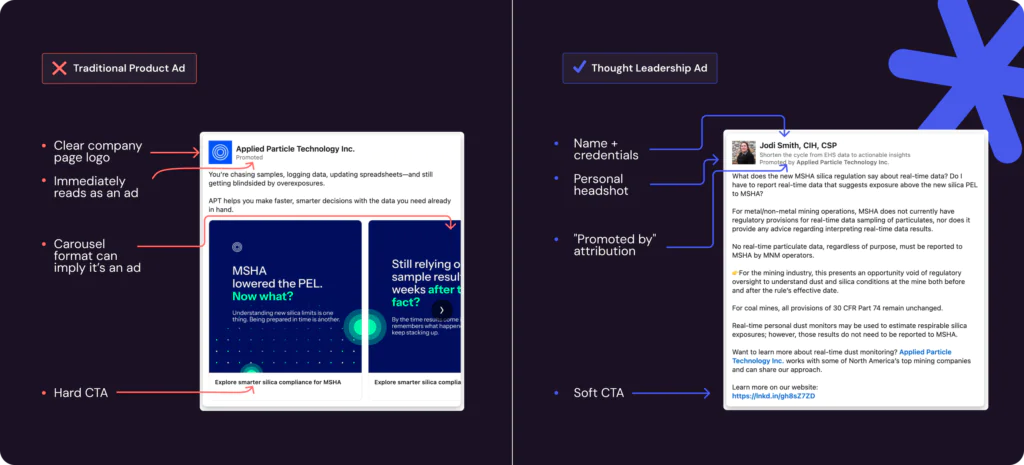
Your audience sees a post from a real person sharing a perspective, insight, or story. It shows up in the feed just like any organic content would, but with paid distribution behind it. That distinction matters more than it might seem.
Why don’t traditional product ads work on LinkedIn anymore?
Here’s the honest truth about B2B advertising right now: buyers are skeptical. Decision-makers have seen thousands of LinkedIn ads promising to “transform their business,” “streamline operations,” or “drive 10x ROI.” The messaging has become so predictable that buyers have essentially developed ad blindness. They know what a product ad looks like, and they scroll past it automatically.
Traditional product ads lead with the company and the solution. Thought leadership ads lead with a person and an idea. That’s a fundamentally different dynamic, and it changes everything about how the content is received.
When someone scrolls past an ad from “Acme Software Co.” promoting their latest feature, they know it’s a pitch. When they stop to read a post from a founder sharing a hard-won lesson or a contrarian take on their industry, they’re engaging with a perspective, not a promotion. The trust is built before the ask is ever made.
How do you use an executive’s existing audience in paid social?
You tap into it by sponsoring content directly from the executive’s own profile. This way, the ad carries their existing credibility instead of starting from zero. It’s one of the biggest missed opportunities in B2B marketing: a CEO has spent years building credibility in the industry. They have LinkedIn followers who already trust them, engage with their posts, and see them as an authoritative voice. That trust is an asset, and most companies leave it almost entirely on the table when it comes to paid advertising.
Thought leadership ads let you tap directly into that existing rapport. When you sponsor content from an executive’s profile, you’re not just boosting a post, you’re extending the reach of a trusted voice to a much larger audience that shares the same professional profile as your existing followers. The people who see the ad receive it the way they’d receive a recommendation from someone they respect, not the way they receive a cold pitch from a brand.
That shift in reception is massive in B2B, where buying cycles are long and trust is the primary currency.
Why does it matter who’s behind the company, not just what they sell?
This isn’t a new insight, but it’s more relevant than ever: buyers want to know who is behind the company, especially in complex B2B sales. They want to understand the philosophy, the approach, the values of the people they’re about to enter into a long-term partnership with. A product ad can tell them what you do. An executive’s thought leadership post can tell them who you are.
That matters because in most B2B categories, the “what you do” is table stakes; there are multiple competitors offering similar solutions. The differentiator is often the relationship, the trust, and the confidence the buyer has that the people behind the product genuinely understand their world. Thought leadership ads build exactly that confidence.
When a founder shares a real perspective—a lesson from a client engagement, a counterintuitive take on an industry trend, an honest acknowledgment of where the market is getting something wrong—they’re showing buyers the kind of thinking that will show up in their partnership. That’s far more persuasive than any feature comparison.

Why does human perspective matter more in an automated marketing landscape?
We’re living through an era of accelerating automation in marketing. AI-generated content, automated outreach sequences, programmatic everything—the volume of brand communication has exploded while the humanity behind it has decreased. Buyers feel it. They know when they’re reading something a machine produced or when an ad was assembled from a template.
In that environment, genuine human perspective is genuinely rare. And rare things have value.
An executive sharing their actual point of view—not polished marketing copy, but real thinking—cuts through because it’s different from almost everything else in the feed. It doesn’t feel like marketing. It feels like a conversation worth having. That’s exactly the kind of first impression you want to make with a potential buyer.
This isn’t just a sentiment; it’s showing up in the data. In Edelman and LinkedIn’s B2B Thought Leadership Impact Report, 71% of buyers said thought leadership demonstrates a vendor’s value more effectively than conventional marketing materials. In categories saturated with product messaging, posts from real people with real perspectives simply perform better.
What makes a thought leadership ad actually work
The format only works if the content delivers real value or a real perspective, not a sales message in a human voice. Four things consistently drive thought leadership ad performance:
- Specificity beats generality. “What I learned after 50 client kickoffs about why strategy gets skipped” outperforms “why strategy matters.” Specific, experiential insights signal credibility and earn engagement.
- Contrarian takes get attention. Posts that thoughtfully challenge a common industry assumption stop the scroll and earn the kind of comments that extend organic reach. (Put your take at the top; LinkedIn cuts off your post after the first 150 characters!)
- Honesty builds trust faster than polish. An executive who admits what didn’t work reads as more credible than one who sounds like a press release.
- The CTA should feel natural. The best-performing posts end with a next step that feels like a logical extension of the conversation, not a hard pivot to a demo request.
What should you look for in a B2B agency partner running LinkedIn ads for you?
Whether you handle this in-house or bring in outside help, three things separate teams that get this format right from teams that don’t:
- Content and paid media come from the same hands. Thought leadership ads live or die on voice; if the person drafting the executive’s post and the person managing the ad spend never talk, the creative reads like it was written by committee. Treat this as one workstream, not a handoff between a content team and a media buyer.
- Reporting is tied to engagement and pipeline, not impressions. A thought leadership ad’s whole value proposition is that it doesn’t look like an ad; so measuring it like one (reach, impressions) misses the point. CTR, comment quality and downstream pipeline are the numbers that actually tell you if it’s working. The 0.44%–0.65% vs. 4.24%–9.67% range cited earlier in this blog is a reasonable benchmark to hold any campaign to.
- They test message and messenger, not just creative. Which executive is posting, and what they’re actually saying, matters more than format tweaks. The best-run programs treat the point of view itself as the thing to iterate on.
It’s time to move beyond traditional product ads
The LinkedIn feed is crowded, and a lot of what’s running is flat, generic messaging that could belong to any company in the category. As a result, buyers have learned to scroll past it. Thought leadership ads offer a fundamentally different approach: they lead with human perspective, leverage the trust your executives have already built, and give buyers a reason to engage before they ever see a pitch.
At Accelity, we’ve seen this format consistently outperform traditional product ads across B2B industries, and we’re recommending it to our clients with confidence. If you’re not yet running thought leadership ads, you’re leaving one of the highest-performing formats in B2B paid social completely untapped.
Ready to put your executives’ expertise to work? Let’s talk about what a thought leadership ad strategy could look like for your team.
Subscribe to our newsletter
Curated content, news articles, team updates and more.

